Materials · Mechanics
Young's Modulus Calculator
Solve E, σ, ε, δ, or F from Hooke's law — pick a mode, plug in your test or design numbers, and see stiffness update as you type.
Result
Young's modulus
E = σ / ε
Pick a solve mode, enter σ and ε, and watch E land in the panel — Hooke's law in one glance.
Elastic stiffness, Hooke's law, and how engineers use E in design.
Young's modulus (elastic modulus, E) measures how stiff a material is in the linear elastic region — resistance to elastic deformation under normal stress. It is the slope of stress versus strain before yield.
- Young's modulusE = σ / ε
- Hooke's lawσ = E · ε
- Stressσ = F / A
- Strainε = ΔL / L₀
- Deformationδ = (F · L) / (E · A)
- ForceF = (δ · E · A) / L
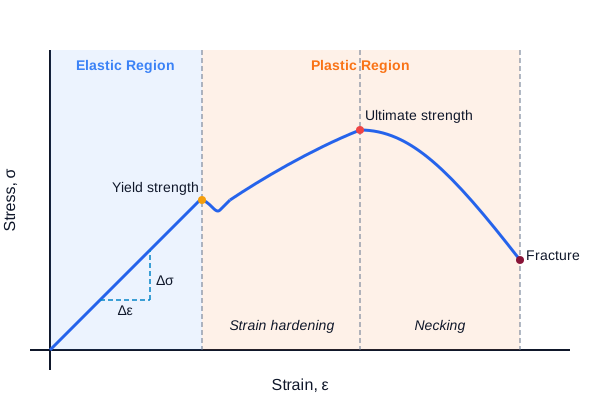
E is the slope of the straight segment in the elastic region. Steeper slope means a stiffer material; beyond the elastic limit, permanent plastic deformation begins.
| Material | E (GPa) |
|---|---|
| Structural Steel | 200 |
| Stainless Steel | 190 |
| Aluminum | 69 |
| Titanium | 110 |
| Copper | 117 |
| Brass | 100 |
| Concrete | 30 |
| Glass | 70 |
| Oak Wood (along grain) | 11 |
| Nylon | 3 |
| Polyethylene (HDPE) | 0.8 |
| Rubber | 0.01 |
Structural design
Beam deflection and column buckling depend on E.
Material selection
Match stiffness to deflection budgets and weight targets.
Finite element analysis
Element stiffness matrices scale with E and geometry.
Spring design
Higher E means less deflection for the same wire geometry.
Vibration
Natural frequencies rise with stiffer (higher E) members.
Quality control
Tensile tests back-calculate E from σ–ε data.
- Valid only in the linear elastic region (before yield or permanent set).
- E varies with temperature — hot service reduces most metals' stiffness.
- Anisotropic materials (composites, wood) have different E along each axis.
- Not applicable once plastic deformation dominates the response.
- Reported handbook values are nominal; lot tests matter for critical parts.
- Diamond has one of the highest known Young's moduli — roughly 1000 GPa along certain axes.
- Rubber's E can be under 0.01 GPa, which is why tires and seals flex so easily.
- The same steel alloy can read different E in tension vs compression if micro-cracks form.
- Thomas Young (1773–1829) also worked on light interference — the modulus name honors his breadth.
- FEA meshes are only as honest as the E and Poisson's ratio you assign to each element.
- A stiffer bar (higher E) carries more load for the same strain — think bridge girders vs nylon rope.